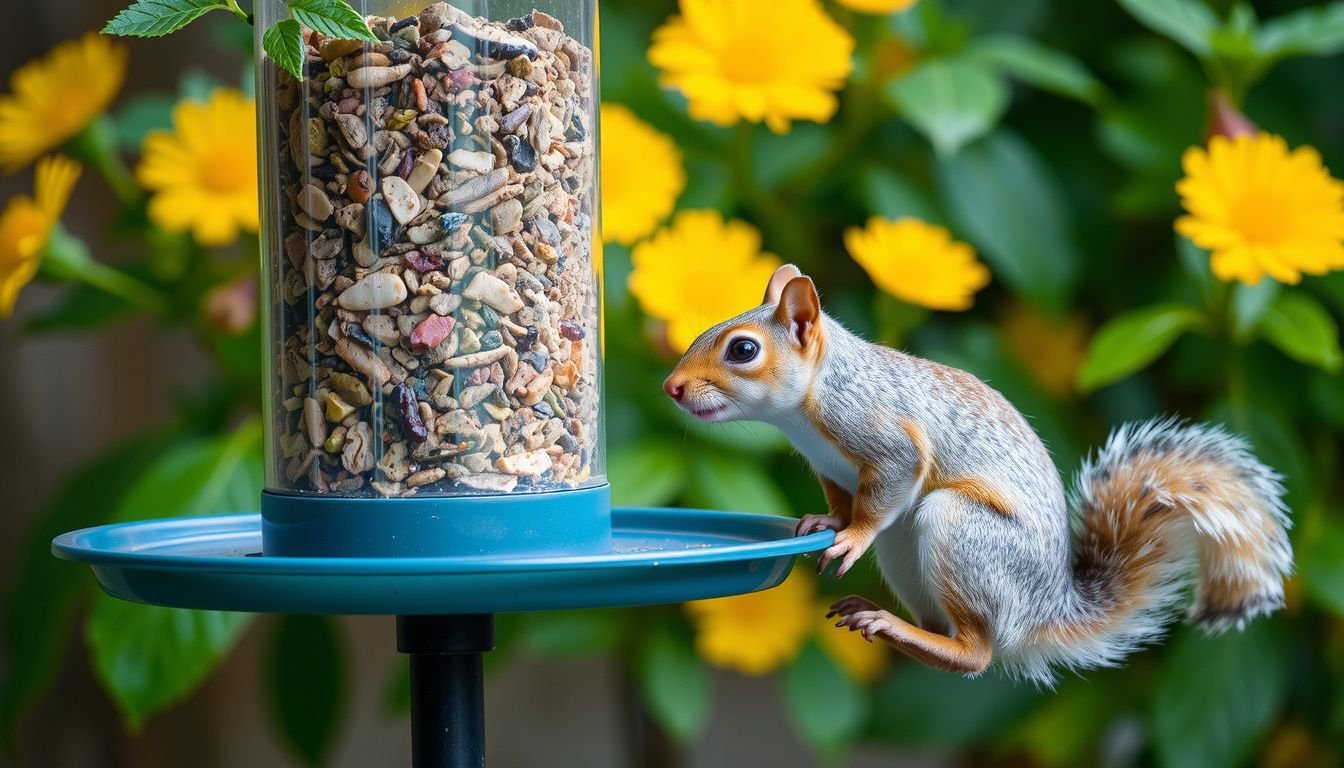
How to get squirrels away from bird feeders — it’s the question every backyard birder eventually asks. Squirrels are persistent, athletic, and surprisingly clever. Left unchecked, they drain feeders in hours and drive away the birds the setup was meant to attract.
The good news: keeping squirrels off bird feeders is entirely achievable with the right combination of placement strategy, feeder design, and deterrents. No single method works for every yard, but layering a few proven tactics produces reliable results.
For example, a homeowner in a suburban backyard moved their pole-mounted feeder just 10 feet away from the nearest tree — that one change, combined with a baffle, reduced squirrel raids by roughly 90% within a week.
This guide covers everything needed to protect a bird feeder setup, including:
- Physical barriers like baffles and cages
- Strategic feeder placement using the 5-7-9 rule
- Squirrel-proof feeder types worth investing in
- Natural and commercial deterrents that actually work
Understand Why Squirrels Target Bird Feeders Before Taking Action
Knowing the enemy is half the battle. Squirrels aren’t simply being destructive — they’re following deeply ingrained survival instincts that make bird feeders an irresistible food source.
Bird feeders offer squirrels three things they constantly seek:
- High-calorie seeds like sunflower seeds and peanuts that fuel energy storage
- Predictable, reliable access — feeders get refilled on a schedule squirrels quickly learn
- Elevation advantage that keeps them away from ground-level predators
Squirrels are also remarkably adaptive problem-solvers. Studies on eastern gray squirrels show they can memorize up to 9,000 food cache locations. Applying that same spatial intelligence to a stationary feeder?
That’s practically effortless for them.
Consider this real-world scenario: a homeowner in suburban Ohio noticed squirrels emptying her feeder within two hours each morning. She assumed random scavenging. In reality, three squirrels had established a feeding rotation — arriving in sequence at predictable intervals.
Understanding this behavior matters because it shapes the solution. Reactive fixes — like shooing them away — accomplish nothing lasting. Effective squirrel deterrence requires disrupting their access patterns, not just their presence.
Recognizing whether the problem involves one opportunistic squirrel or an established feeding habit determines how aggressive the approach needs to be.
Gather the Right Tools and Supplies for Squirrel-Proofing
Now that the behavior is clear, preparation comes next. Having the right equipment before making changes saves time and prevents half-measures that squirrels exploit within days.
Here’s what a well-equipped squirrel-proofing setup typically includes:
- Squirrel baffle — dome or cylinder style, mounted on the feeder pole
- Pole-mounted feeder system — smooth metal poles are far harder to climb than wood or plastic
- Caged bird feeder — wire cages allow small birds through while blocking squirrels
- Safflower or nyjer seed — seeds squirrels actively avoid but birds love
- Measuring tape — critical for verifying placement distances
One practical example: a birder in Portland replaced a wooden shepherd’s hook with a smooth steel pole and added a torpedo baffle. Squirrel visits dropped from daily to zero within a week — no repellent sprays required.
Budget matters here. A quality baffle runs $15–$40. A full pole-and-baffle system can reach $60–$80.
Investing upfront in durable hardware consistently outperforms cheap plastic alternatives that crack, warp, or fail within a single season.

Gather supplies before repositioning anything. Moving a feeder without the right hardware in place simply relocates the problem.
Choose and Position a Squirrel-Resistant Bird Feeder Correctly
With a clear understanding of squirrel behavior in hand, the next move is selecting the right feeder — and placing it strategically. Feeder design matters enormously. Not all “squirrel-proof” feeders are created equal.
The most effective options share a few key traits:
- Weight-sensitive perches that collapse under a squirrel’s heavier body mass, closing seed ports automatically
- Caged outer shells with wire spacing narrow enough to exclude squirrels but wide enough for small songbirds
- Smooth, elongated tubes that offer no grip points for climbing
Placement is just as critical as the feeder itself. Squirrels can leap up to 10 feet horizontally and 5 feet vertically. That math has to inform every positioning decision.
Follow the 5-7-9 rule: hang or mount feeders at least 5 feet off the ground, 7 feet away from any structure, tree trunk, or fence, and 9 feet below any overhanging branch.
A practical example: a homeowner in a suburban backyard switches from a basic tube feeder mounted on a fence post to a weight-activated feeder hung from a shepherd’s hook placed 8 feet from the nearest shrub. Squirrel visits drop to near zero within a week.
Avoid mounting feeders directly on trees. That’s essentially handing squirrels a runway.
Install Physical Barriers and Baffles to Block Squirrel Access
Even the best feeder placement benefits from an added layer of physical defense. Baffles are the industry standard — and for good reason. They work.
There are two primary baffle types to know:
- Pole-mounted baffles: Dome or cylinder-shaped shields that wrap around the feeder pole, preventing squirrels from climbing up from below
- Hanging baffles: Mounted above a suspended feeder, these block squirrels from descending down the wire or chain
For pole-mounted setups, a torpedo or stovepipe baffle positioned at least 4 feet off the ground is the most reliable choice. The smooth, curved surface gives squirrels nothing to grip.
Look for baffles with a diameter of at least 15 inches. Anything smaller and an athletic squirrel will simply reach around it.
Real-world example: a birder in the Pacific Northwest installs a 18-inch diameter stovepipe baffle on a steel pole feeder. Despite daily squirrel attempts, none successfully breach it over an entire season.
One common mistake — mounting the baffle too low. If it sits under 4 feet, squirrels jump directly past it. Height is non-negotiable.
Apply Squirrel Deterrents Without Harming Birds or Wildlife
With baffles and feeders properly positioned, the next layer of defense involves active deterrents. The goal is discouraging squirrels — not harming them or disrupting the birds already visiting the setup.
Capsaicin-based repellents are among the most effective and wildlife-safe options available. Birds lack the receptors that detect capsaicin heat, so hot pepper additives mixed directly into birdseed create zero discomfort for feathered visitors. Squirrels, however, find the sensation deeply unpleasant and quickly learn to avoid treated feeders.
Common deterrent methods that work without causing harm:

- Hot pepper seed blends — pre-mixed or DIY with cayenne powder
- Safflower seed substitution — most squirrels dislike its bitter taste; cardinals love it
- Motion-activated sprinklers — a sharp water burst redirects squirrels without injury
- Spinning or weight-sensitive feeder ports — closes under a squirrel’s heavier body weight
A practical example: one backyard birder in Ohio switched entirely to safflower seed after persistent squirrel raids. Within two weeks, squirrel visits dropped to near zero while goldfinch and chickadee activity actually increased.
Avoid mothballs, predator urine sprays near feeders, or sticky substances on poles. These can stress or injure birds and other non-target wildlife. Effective deterrence is always targeted and reversible.
Maintain the Setup and Monitor Results Over Time
Squirrel-proofing isn’t a one-time fix. Squirrels are persistent problem-solvers — they test boundaries repeatedly and adapt. Consistent monitoring is what separates a setup that holds long-term from one that fails within a month.
Check the feeder station weekly for these key issues:
- Baffle position shifting due to wind or animal contact
- Seed spillage on the ground attracting squirrels from below
- New tree limbs or structures that close the 10-foot clearance gap
- Feeder damage indicating squirrels are still reaching it
Seed management matters more than most people expect. Cleaning up fallen seed daily removes the ground-level reward that keeps squirrels motivated to keep trying. No reward means reduced persistence.
Seasonal adjustments are also necessary. In late fall, squirrels intensify foraging before winter — that’s the time to reinforce deterrents, not react after the fact.
Track what’s working by observing bird activity patterns. Increased bird visits combined with fewer squirrel sightings signals a successful, balanced setup. Adjust one variable at a time so results stay interpretable and improvements stay measurable.
Quick Answers
Will cayenne pepper in bird seed hurt the birds?
No. Birds lack the capsaicin receptors that make hot peppers uncomfortable for mammals. Mixing cayenne directly into seed is safe for birds and creates an effective deterrent.
Use roughly one tablespoon per pound of seed and reapply after rain.
How far can squirrels actually jump horizontally?
Squirrels can leap up to 10 feet horizontally from a running start. When positioning feeders, maintain a minimum 10-foot clearance from trees, fences, rooftops, and any elevated surface a squirrel could use as a launch point.
What should someone do if squirrels keep bypassing a baffle?
Check the baffle diameter first — it must be at least 17 inches wide. If squirrels are climbing past it, the pole may be too close to a structure. Reposition the pole and ensure the baffle sits at least 5 feet off the ground.
Next Steps
Squirrel-proofing a bird feeder isn’t a one-time fix — it’s a layered system. The most successful setups combine physical barriers, smart feeder placement, and periodic maintenance into a single, consistent routine.
Here’s a practical example: a homeowner in a suburban backyard with mature oak trees nearby faces a particularly tough challenge. Squirrels have multiple launch points, abundant food motivation, and high persistence. In that scenario, relying on a single baffle alone won’t cut it.
The winning approach stacks a pole-mounted baffle, a weight-sensitive feeder, and cayenne-treated seed — all positioned well away from the tree line.
Before wrapping up, here’s a prioritized action list for anyone starting fresh:
- Start with placement — no deterrent compensates for a poorly positioned feeder.
- Install a quality baffle — it’s the single highest-impact physical barrier available.
- Add a secondary deterrent — cayenne seed or a weight-sensitive feeder closes remaining gaps.
- Check the setup monthly — squirrels adapt, and the system needs to adapt with them.
The honest verdict: most people who fail at keeping squirrels away from bird feeders skip the positioning step entirely. They invest in expensive equipment, place it in the wrong spot, and wonder why squirrels still win. Placement isn’t a detail — it’s the foundation.
Consistency is what separates a feeder that attracts birds from one that feeds squirrels. Set it up correctly, monitor results every few weeks, and adjust when needed. Birds will follow.