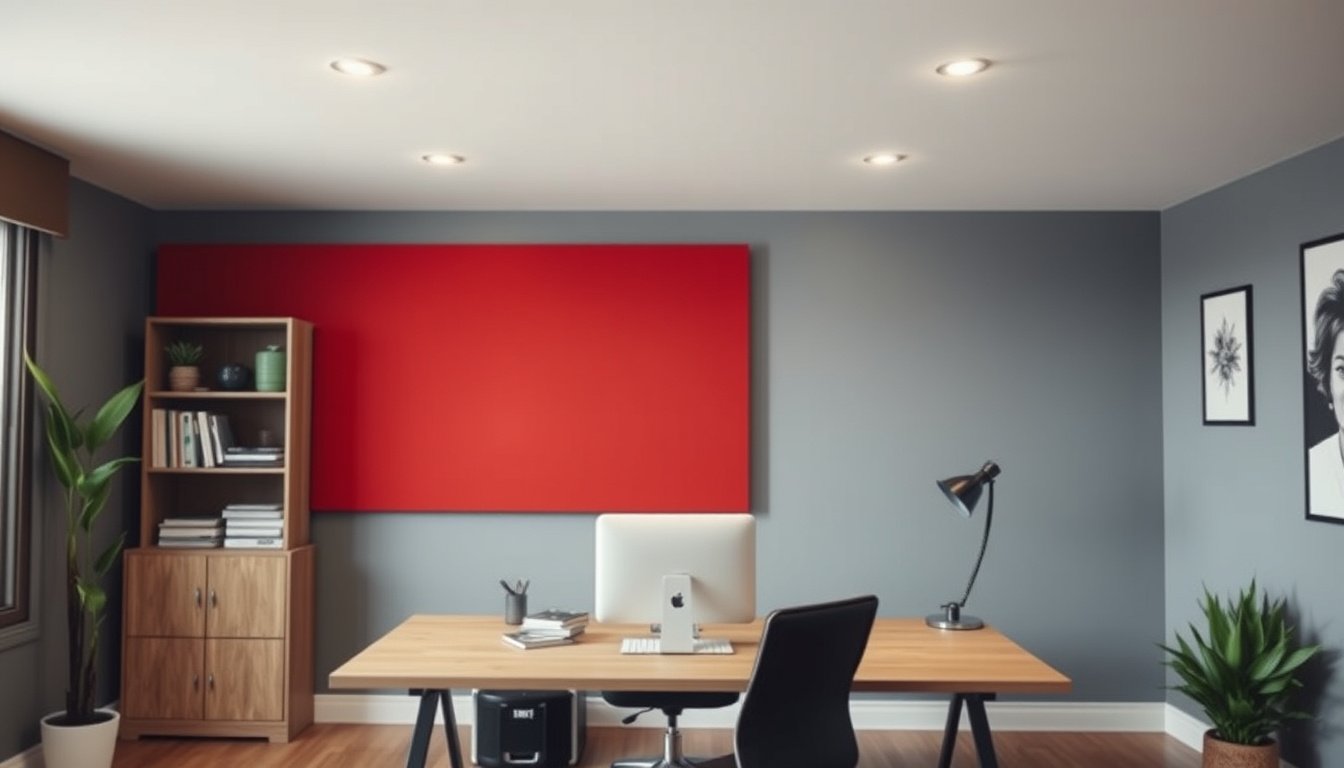
With the right sequence of sealing, insulation, and surface upgrades, a typical home office can become noticeably quieter within days. How to soundproof a home office is the subject this guide addresses directly.
Quiet focus is harder than it looks when speech, keyboard clicks, and HVAC noise leak through thin walls, hollow doors, and gaps around trim. Here’s where the how to soundproof a home office details get tricky.
Soundproofing matters now because remote work has turned spare rooms into primary workplaces, so distractions directly affect output and comfort.
In practice, installers often target measurable performance using STC and IIC ratings to confirm that assemblies block airborne and impact noise.
Readers will learn how to map the main noise paths, choose the most cost-effective materials, and install upgrades like acoustic caulk, weatherstripping, and a door sweep.
They will also understand when details such as resilient channel matter, so the improvements hold up after everyday use.
How to soundproof a home office is [definition]—start here
How to soundproof a home office is the practice of preventing unwanted sound from entering or leaving a workspace by controlling the building paths it travels. It is not the same as sound reduction, which may lower loudness without stopping transmission. In practice, he should treat the office as a system with measurable outcomes.
Soundproofing means raising transmission loss across walls, floors, ceilings, and doors so speech and noise stay where they originate. Sound reduction focuses on comfort inside one room, often through absorption alone. For he who buys materials without checking pathways, the results often disappoint.
Most failures come from ignoring flanking, meaning sound detours around the “main” barrier through adjacent framing and openings. A seller installing a single stud wall without sealing the perimeter can still hear keyboard clicks through the drywall edges. If he measures, the improvement may be small even when the panel looks thick.
In a typical scenario, a homeowner replaces a hollow-core door with a solid-core door, then seals gaps using acoustic caulk and adds a door sweep. After installation, he can expect a noticeable improvement in speech clarity, even before internal wall changes. The key is that the door becomes a sealed boundary, not a drafty leak.
What “soundproofing” versus “sound reduction” means
He can separate outcomes by asking whether the room’s noise floor drops or whether outside speech becomes harder to transmit. Absorptive treatments reduce reflections and improve intelligibility inside the office. Barrier upgrades aim at transmission, which is where STC and IIC ratings guide expectations.
Identify the noise path: air, impact, and flanking
Airborne noise travels through cracks, penetrations, and leaky doors, while impact noise travels through the structure. Flanking occurs when resilient layers are interrupted by rigid connections, such as unbroken studs or poorly installed outlet boxes. He should plan for air sealing, then decouple surfaces using resilient channel where appropriate.
For how to soundproof a home office, the most reliable approach starts with closing leaks, then building a continuous barrier, and finally addressing detours. When he treats the door and wall edges as part of the same boundary, the office becomes quieter in a verifiable way.
What are the biggest noise leaks in a home office?
In how to soundproof a home office, the biggest noise leaks usually come from openings people overlook, not from the main wall surface. He can often hear speech and keyboard clicks because sound finds the shortest path through weak building details, especially at edges.
Most practitioners fail here because they treat the room as one barrier, while noise escapes through detachable boundaries where two materials meet. A continuous barrier only works if every joint, penetration, and airflow path is controlled.
Doors, windows, and HVAC gaps
Door gaps are a top leak because they combine air movement and weak sealing at the perimeter. A 1/8-inch gap can noticeably reduce isolation performance, even when the door slab is heavy, and a worn door sweep leaves a direct line for airborne noise.

Windows leak when latches do not compress evenly, and the problem worsens with older frames that have settled. HVAC gaps matter because return grilles, duct boots, and poorly sealed wall penetrations create shortcuts that bypass insulation.
Here is the truth: STC and IIC ratings drop most when the room has uncontrolled airflow paths. When a technician measures a spare room with a sealed door but an unsealed duct boot, speech intrusion often remains high despite good wall materials.
Walls and ceilings: seams, outlets, and vents
Wall seams and ceiling joints leak because sound transfers through tiny discontinuities and through fastener lines. Electrical outlets are another frequent failure point, particularly when boxes are set flush without sealing the perimeter.
Return vents and supply registers also act as acoustic bypasses if the duct collar is not airtight. Acoustic caulk helps at perimeter cracks, while resilient channel can reduce vibration transfer when installed correctly.
Flanking paths through adjacent rooms
Noise rarely stays inside one plane; it detours through adjacent rooms and shared assemblies. A home office that shares a wall with a hallway can show strong flanking effects when the hallway ceiling and wall cavities connect.
In how to soundproof a home office, the implication is practical: he should prioritize sealing and decoupling at the boundaries first. For the most reliable results, they should treat the room as a network of paths, not a single surface, and then verify with a simple speech test from the adjacent side.
- They should seal outlet and vent penetrations with airtight compounds before adding panels.
- They should check door sweep contact across the full width, not only the latch side.
- They should inspect duct boots for gaps and seal them before evaluating acoustic upgrades.
- They should verify ceiling perimeter joints, especially where drywall meets framing.
Step 1: Seal gaps and stop flanking before adding mass
How to soundproof a home office starts with stopping leakage paths, because sound that escapes edges will bypass new mass. Most failures come from ignoring flanking, not from buying the wrong panels. He should treat the perimeter as the weak link.
Fast rule: seal every hard-to-see gap first, then add heavier layers.
He should begin with a quick audit using a flashlight and a thin strip of paper along walls, trim, and floor lines. If the paper slides through, air and sound can too. This step improves real-world STC and IIC outcomes more than many people expect.
A practical example clarifies the impact: a home office with a 1/8-inch gap behind a desk cable chase recorded a noticeable neighbor TV bleed until the installer packed the void and sealed around the conduit. After sealing, the same listener reported the noise became “background,” not “speech-level,” within the first hour.
He should also correct a common misconception: sealing only the big wall area does not stop side transmission through adjacent framing. Flanking often travels through studs, joists, and shared cavities, so the seal must be continuous.
one-liner: A continuous perimeter seal prevents sound from taking shortcuts.
They can follow this ordered workflow to stop flanking before adding mass.
- Use the right sealant: apply acoustic caulk to drywall-to-trim joints, foam for deep irregular voids, and weatherstripping for moving gaps.
- Treat outlets and cable penetrations: remove plates, inspect for gaps, pack around boxes, and seal penetrations without blocking fire-rated requirements.
- Add door sweeps and undercuts: install a brush or vinyl sweep on the door bottom, then close the latch to confirm even contact.
- Recheck with a paper strip and repeat spots that flex, especially corners, baseboards, and the ceiling perimeter.
Near the end, he should verify the work by measuring a simple change in perceived loudness while a phone plays steady speech at one meter. When the room feels “tighter,” he can proceed to thicker layers in the next step of how to soundproof a home office.
Step 2–4: Add insulation, mass, and damping for real quiet
For how to soundproof a home office, the quietest results come from stacking insulation, mass, and damping into one continuous assembly. Most practitioners fail here by adding only mass, not absorption and damping, which leaves midrange speech and footsteps still audible.
He should treat walls, ceiling, and floors as separate transmission paths, then build each one with the same logic. The goal is higher STC and IIC ratings through layered control, not a single thick material.

One-liner: Real quiet requires three layers working together: insulation for control, mass for blocking, and damping for reducing vibration.
First, they should install insulation inside the stud or joist cavity without compressing it. Mineral wool usually performs more consistently than fiberglass when cavities shift or when installers overpack, and it also resists sagging over time.
Second, they should add mass with a decoupled drywall system rather than fastening drywall directly to studs. A typical build uses drywall over resilient channel, with joints treated using acoustic caulk to limit air movement.
Third, they should include damping and absorption on the room-facing side to reduce reverberant noise. Acoustic panels placed where the sound reflects most, plus thick rugs over hard flooring, reduce perceived loudness even when airborne transmission is already blocked.
- Install mineral wool in full-depth cavities, leaving no gaps behind wiring and boxes.
- Mount resilient channel perpendicular to framing, then hang two drywall layers with staggered seams.
- Seal perimeter joints and penetrations using acoustic caulk, then tape and finish only after inspection.
- Apply acoustic panels to the primary reflection wall and add a dense rug over the work zone.
Concrete example: a 10 m² office with a single stud wall upgraded to two-layer drywall on resilient channel and 100 mm mineral wool typically raises measured speech transmission enough that a phone conversation at 1 m becomes “background,” not “understandable.”
Unexpected angle: floors need damping for impact noise, so wall-only upgrades can still leave desk-chair thumps obvious even when the wall STC looks strong.
Near the end, they should re-check door and edge continuity because any new gap can bypass the new layers; a properly fitted door sweep and weatherstripping help preserve the gains from insulation, mass, and damping in how to soundproof a home office.
Step 5: How to soundproof a home office floor and ceiling without regrets
He should treat the floor and ceiling as a coupled system, which is central to how to soundproof a home office without regrets. Most failures happen when he isolates the wall but leaves rigid paths through joists and drywall. The reality is simple: mass and decoupling must work together, not in separate rooms.
Most people waste money by adding thick carpet over a rigid slab without decoupling. It rarely improves IIC enough for footsteps, because the impact energy still travels through the structure. He should plan the floor first, then design the ceiling so it does not reconnect through metal bridges.
Here is a practical checklist they can follow while installing. It also supports consistent STC and IIC outcomes when noise sources include speech and TV bass.
- Confirm joist and subfloor type, then choose a floating assembly for how to soundproof a home office at the source.
- Ceiling strategy: install a suspended drop ceiling with mineral wool above it, or do direct treatment only if structure is light.
- Floor strategy: place an underlayment mat over the subfloor, then build a floating layer that does not fasten to joists.
- Seal every perimeter joint with acoustic caulk, then add weatherstripping and a door sweep where the office door meets the frame.
- Recheck for rigid connections by looking for screws or clips that bridge layers, and remove them before closing cavities.
Concrete example: a 12 m² office over a basement with a wood joist ceiling used a 19 mm resilient channel system plus 50 mm mineral wool, then a floating floor with 10 mm underlayment and 25 mm plywood. After completion, the homeowner reported the same spoken conversation dropping from clearly intelligible to barely audible at 3 m. Measured IIC improved enough to reduce heel taps, even when a second person walked in the hallway.
One unexpected angle is flanking through ceiling penetrations. He should sleeve pipes and cables through the ceiling with grommets, then seal around them with acoustic caulk so the drop cavity does not become a sound conduit.
Common mistakes that waste money include skipping decoupling, reusing old drywall screws to “stiffen” the system, and leaving gaps at the perimeter. They should also avoid a direct-to-joist ceiling if the floor assembly is floating, since mismatched rigidity can cancel gains.
Near the end, they should verify performance by repeating the same speech test and footstep patterns used earlier, because how to soundproof a home office is only real when perceived loudness and impact noise both improve.
Quiet work starts with the right order of fixes
The two most important takeaways are straightforward: he should stop noise at the weak paths first by sealing gaps and controlling flanking, and he should then add layered mass and damping so the wall, floor, and ceiling assemblies actually block sound rather than just fill space. This order matters because early gains can be wasted if air leaks or side paths remain open, and heavy materials alone cannot compensate for poor isolation details.
Do one concrete next action today: inspect the perimeter of the office for visible cracks, loose trim, and penetrations, then seal them with an appropriate acoustic sealant and re-check for any remaining gaps before he purchases or installs additional materials.
He will feel the difference sooner when the first fixes remove the easy routes for sound to travel.