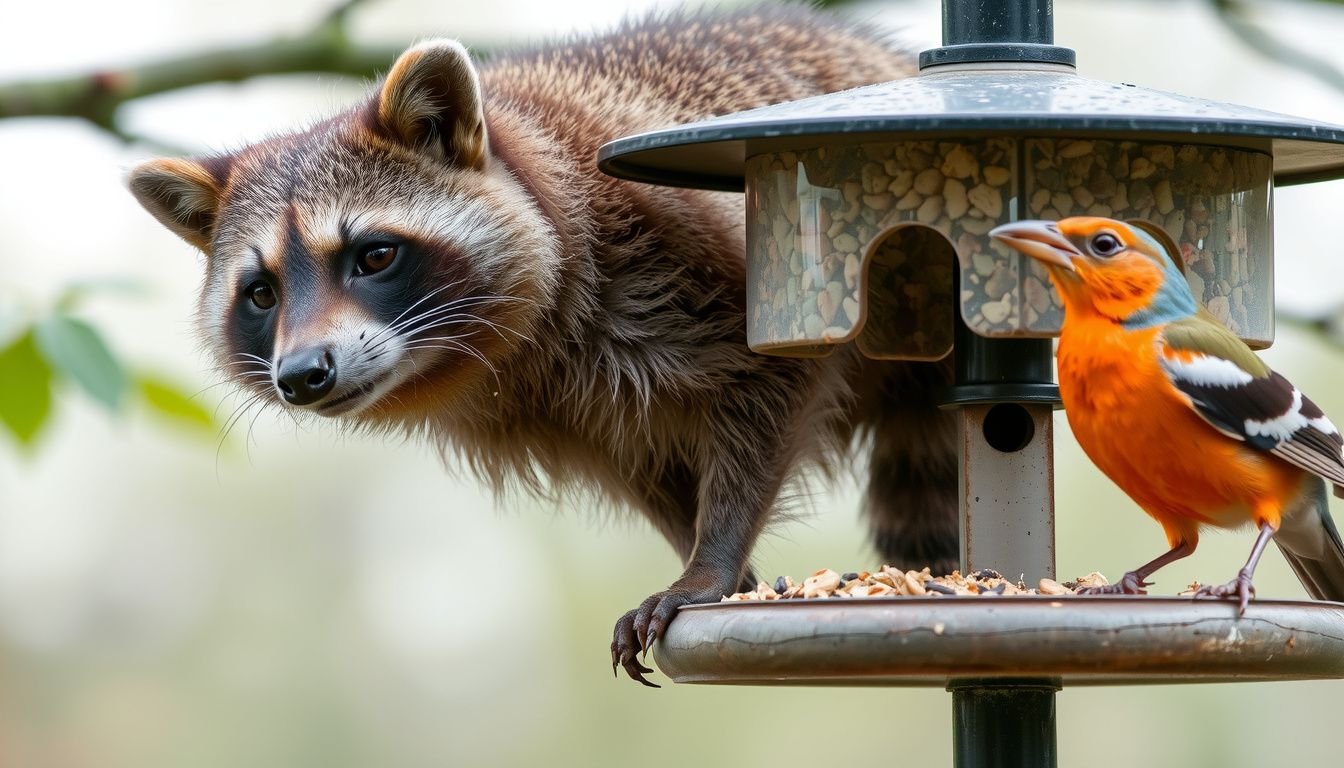
How to keep raccoons off bird feeders starts with accepting one thing: raccoons are strong, clever, and persistent at night. They don’t just steal seed. They bend poles, pry lids, and scare away the birds the feeder was meant to support.
A reliable fix comes from a simple process: confirm the culprit, remove access routes, then block climbing with the right hardware. After that, reduce what’s drawing them in after dark. Each step builds on the last, so skipping ahead usually wastes money and time.
Look for repeatable patterns. When a setup is raccoon-proof, it stays quiet overnight and still feeds birds safely in the morning.
Confirm It’s Raccoons and Identify How They’re Reaching the Feeder
They should verify the animal first. Raccoons typically visit after dusk, leave scattered seed, and may twist a feeder or pull it down. Their tracks look like small human hands, often near the pole base or on a deck rail.
Next, they should identify the access path. Raccoons rarely “jump straight up” from open ground; they use nearby launch points and climbable surfaces.
- Climb route: straight up a pole, shepherd’s hook, chain, or deck post.
- Jump route: from a railing, stump, patio furniture, or low branch.
- Reach route: hanging feeder too close to a roof edge or tree trunk.
Pro tip: a cheap trail camera or phone night mode from a window can confirm the approach in one night. Common mistake: blaming squirrels, then buying squirrel-only guards that raccoons can overpower.
Before You Start: Gather Tools, Choose a Feeder Style, and Set a Baseline
They should set a baseline for one week: note the time of raids, how much seed disappears, and whether the feeder is damaged. That baseline makes it obvious which change actually worked.
Then they should gather the right tools and decide whether the feeder itself needs an upgrade. Many “wildlife resistant” models are designed for squirrels, not raccoons.
- Measuring tape, adjustable wrench, and a level
- Stove pipe or cone baffle sized for the pole
- Metal pole (smooth, 1–1.25 inch diameter) and ground auger or sleeve
| Feeder type | Best use | Raccoon risk |
|---|---|---|
| Tubular with weight-activated ports | Mixed songbirds | Medium (needs baffle) |
| Hopper feeder | High volume yards | High (easy to pry/chew) |
| Suet cage | Woodpeckers | High at night (limit hours) |
Pro tip: metal beats plastic for raccoon pressure points. Common mistake: starting with deterrent sprays; rain and dew erase them fast.
Relocate and Mount the Feeder to Remove Jumping and Climbing Routes
They should move the feeder before buying more gear. Placement fixes more problems than most “repellent” products.
They should choose an open spot where raccoons can’t jump from a structure. A good rule: keep the feeder at least 10 feet from any launching surface and 6 feet from overhanging branches. If mounting near a deck, they should avoid railing hooks and instead use a dedicated pole set in the yard.
- Pick a location with clear space in a 10-foot radius.
- Mount the feeder so the bottom sits 5–6 feet high (easy to service, harder to reach).
- Remove “step stools” like stacked planters, grills, or benches near the pole.
Practical example: They moved a feeder from a deck hook to a smooth pole 12 feet into the lawn, away from a maple branch. The nightly seed loss stopped immediately, even before adding a baffle.
Common mistake: hanging the feeder from a tree limb; raccoons treat branches like highways.
Install the Right Baffle and Pole Setup to Block Climbing Access
They should assume raccoons will climb unless the pole is smooth and protected. The goal is a “no-grip” zone that forces them to slide back down.
A cone baffle or large stove-pipe baffle works best when installed correctly. Small baffles often stop squirrels but fail against raccoon reach and weight.
- Use a smooth metal pole, not textured paint or wood.
- Install the baffle 4–5 feet above ground so raccoons can’t reach over it.
- Choose a baffle at least 8 inches wide (10–12 inches is safer for raccoons).
Pro tip: tighten hardware monthly during peak activity; raccoons loosen bolts by repeated pushing and pulling. Common mistake: placing the baffle too high; raccoons then climb up to it and simply hang and reach around.
Reduce Nighttime Attractants with Timing, Seed Control, and Cleanup
They should treat raccoon control as both access control and food control. If the yard smells like an all-night buffet, raccoons will keep testing defenses.
They should stop feeding overnight when raids are active. Many songbirds feed early, so pulling feeders at dusk and putting them back at dawn can break the habit fast.
- Bring feeders in at night or use a pulley system for quick removal.
- Use seed trays sparingly; spilled seed is a magnet.
- Rake or sweep hulls and spilled seed every 2–3 days.
They should also secure other attractants: trash lids, compost, pet food, and grease drips under grills. Pro tip: store seed in sealed metal containers; raccoons can chew thin plastic. Common mistake: leaving suet out overnight during warm months.
Troubleshoot Persistent Raids and Maintain a Raccoon-Resistant Setup
If raids continue, they should assume one of three issues: a hidden launch point, an undersized baffle, or a feeder that’s easy to pry open.
- They’re still jumping: measure again; move the pole farther from railings, fences, and branches.
- They’re bypassing the baffle: upgrade to a larger diameter baffle and lower it to the correct height.
- They’re damaging the feeder: switch to metal construction and locking lids or remove the feeder nightly.
They should perform a quick monthly inspection: check pole wobble, tighten clamps, and confirm the baffle spins or slides freely. If the baffle gets sticky from sap or dirt, they should wash it with mild soap and water.
Pro tip: if local rules allow, a motion-activated light can increase caution, but it won’t replace proper mounting. Common mistake: relying on noise makers; raccoons habituate quickly.
People Also Ask
Will cayenne pepper or hot seed stop raccoons?
It’s unreliable. Raccoons have sensitive paws, but rain and dew dilute coatings, and they’ll often eat through mild irritants. Physical exclusion (pole placement plus a large baffle) works longer.
How high should a bird feeder be to deter raccoons?
Height alone won’t do it. They should mount the feeder about 5–6 feet high for serviceability, then prevent climbing with a smooth pole and a baffle placed 4–5 feet above ground.
Do raccoons come out during the day to eat bird seed?
Mostly at night, but daytime visits happen in quiet neighborhoods or during food scarcity. If they’re appearing in daylight, they should tighten food control and check for nearby den sites.
You’re Ready
They can keep raccoons away by following a sequence that removes opportunity: confirm the access route, relocate the feeder into open space, then install a correctly sized baffle on a smooth pole. After that, they should cut nighttime rewards by bringing feeders in at dusk, reducing spills, and securing trash and pet food.
Next actions are simple: measure clearances, upgrade the pole-and-baffle setup if needed, and run a one-week check to confirm raids stopped. When the yard stays quiet overnight, the birds get the seed instead of the masked bandits.
Related read: How to Keep Raccoons Away From Bird Feeders Step-by-Step