

You study a chapter at night, feel confident the next morning, and then discover that much of it has vanished. The problem may not be your effort. Sleep helps determine whether new information is absorbed, stabilized, and available for later use.
Memory consolidation is the process by which a fragile new memory becomes more durable. It begins before learning: getting enough sleep helps prepare the brain to take in information. Sleep after learning then helps preserve what you practiced or studied, rather than leaving it vulnerable to interference (Sleep Foundation). Sleep deprivation can disrupt acquisition, consolidation, and recall, while also weakening concentration and decision-making (Harvard Medical School).
Researchers most often discuss two sleep phases in relation to consolidation: non-rapid eye movement (NREM) sleep, especially deep or slow-wave sleep, and rapid eye movement (REM) sleep. NREM sleep is commonly linked with strengthening factual and event-based memories, while REM sleep is often discussed in relation to emotional memories, skills, and the integration of information. These roles overlap, and the exact mechanisms remain an active area of research.
During sleep, the brain is not simply switched off. Memory-related communication involves regions such as the hippocampus and thalamus, which help coordinate information across brain networks. Thus, the idea that “sleep enhances memory consolidation” is not a slogan; it reflects an ongoing biological process that supports learning and remembering.
How sleep affects learning and memory (the short answer)
Sleep affects memory at every stage of learning: too little or repeatedly interrupted sleep makes it harder to take in information, stabilize it, and retrieve it later. Before learning, inadequate sleep reduces alertness and concentration, so acquisition suffers—you may read a page, attend a lecture, or practice a skill without fully registering the details. As Harvard’s sleep education program explains, sleep loss makes it more difficult to focus on and gather new information, while also weakening the ability to remember it later (Harvard Medical School).
After learning, sleep gives the brain time to process and strengthen new information. Both non-rapid eye movement (NREM) and rapid eye movement (REM) sleep contribute to this process, so a short night can leave a memory less stable and easier to confuse or lose. Research reviews link sleep deprivation with disrupted brain changes involved in memory, including synaptic plasticity, and with weaker attention and memory accuracy (Frontiers). This is why sleep deprivation impairs memory formation and recall, not just energy or mood.
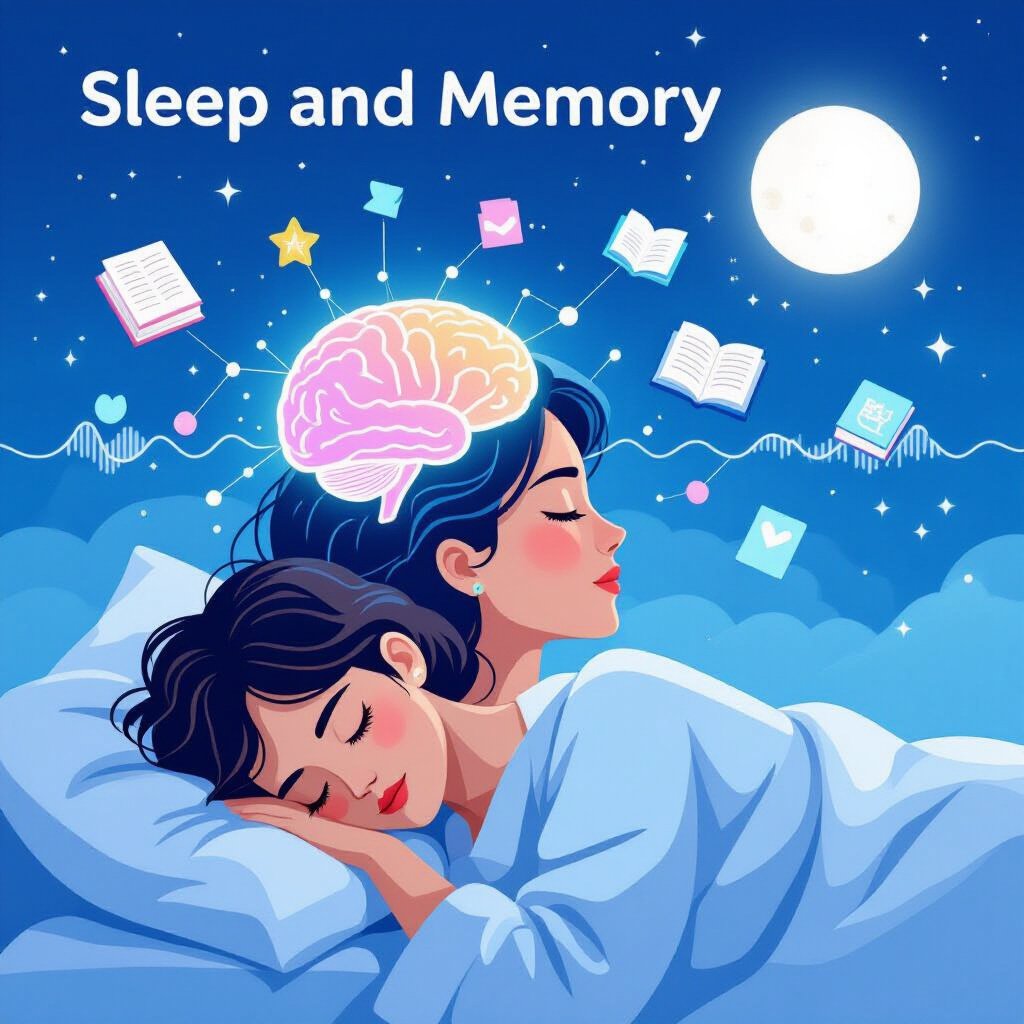
Fragmented sleep can create a similar problem even when the total time in bed looks adequate. Frequent awakenings break up the continuous sleep needed for the brain to move through its normal NREM and REM pattern. As a result, newly learned material may receive less consistent processing, and the next day’s recall can feel incomplete or unreliable. In practical terms, inadequate sleep reduces the quality of input, while fragmented sleep repeatedly interrupts the brain’s work after learning. Both can impair concentration, decision-making, and emotional control as well as memory (Sleep Foundation).
Sleep’s role in memory consolidation: what changes during the night
Sleep loss tends to damage declarative memory more visibly than non-declarative memory, although both systems can be affected. Declarative memory covers facts, concepts, and personal events—the information you might need to explain on an exam or describe in a meeting. It depends strongly on the hippocampus, so disrupted or shortened sleep can interfere with how newly learned information is stabilized for later recall. Research reviewing sleep deprivation finds effects on both declarative and non-declarative long-term memories, but the systems do not respond in exactly the same way (Frontiers).
Non-declarative memory supports skills, habits, and learned responses, such as typing, riding a bicycle, or following a familiar procedure. These memories rely more on brain areas outside the hippocampus. Sleep loss may therefore leave a practiced routine feeling relatively intact while making it harder to remember the explanation, rules, or steps associated with that routine. The distinction is not absolute: severe or repeated sleep disruption can weaken performance across memory systems.
During sleep, the brain isn’t simply switched off. It continues processing recently learned material, helping preserve useful information and connect it with what you already know. Sleep before learning also matters because a tired brain is less prepared to take in new material; sleep afterward helps protect what was learned, as the Sleep Foundation explains. This is why an all-night study session can produce a false sense of progress: the material may have been exposed to the brain, but poor sleep leaves less of it available for recall. The broader relationship between sleep and cognition depends not only on total sleep, but also on its quality and regularity; both insufficient and fragmented sleep can undermine learning and memory.
Which memories sleep supports: declarative, non-declarative, and the control systems that guide them
Sleep supports different memory systems in different ways, while brain networks for cognitive control help decide what to learn, protect, and retrieve.
| Memory system or network | What sleep supports | Why it matters |
|---|---|---|
| Declarative memory | Facts, vocabulary, concepts, and personal events depend strongly on the hippocampus and related cortical networks. Sleep helps stabilize these memories so they can be accessed later. | Reviewing material before bed may help, but sleep afterward is important for preserving what was learned. |
| Non-declarative memory | Skills, habits, and conditioned responses rely more on brain areas outside the hippocampus. Sleep can still strengthen these forms of learning, even when the benefits are less obvious on a quiz. | Practice is not finished when you stop. Sleep may help make a procedure smoother and more automatic. |
| Cognitive-control systems | Regions in the frontal brain and their connected networks help regulate attention, working memory, planning, decision-making, and retrieval. Sleep loss can weaken this control, making it harder to focus on relevant information or suppress distractions. | A tired learner may know the material but struggle to organize an answer, monitor mistakes, or choose the right strategy. |
The distinction is useful, but it isn’t absolute. Sleep deprivation can affect learning, concentration, decision-making, and emotional control alongside memory, as the Sleep Foundation explains. Research also contrasts hippocampus-dependent declarative memories with non-declarative memories supported by other circuits, while examining sleep’s effects on cognitive control (Frontiers).
In practical terms, sleep before studying helps prepare the brain to take in information; sleep afterward helps preserve it. That is the central lesson behind resources such as Memory, Thinking and Sleep from the Sleep Health Foundation: memory and thinking are connected systems, not separate outcomes.
What sleep deprivation does to the brain systems behind learning and recall
Timing matters because circadian processes influence alertness across the day. A person may understand complex material more easily during their naturally alert period than during a biological low point, even if the clock says both sessions are equally long. Bright light, especially later in the evening, can delay the body’s timing signals and make it harder to become sleepy at the intended bedtime. That can shift study into a period of reduced alertness or shorten the sleep that follows. Morning and daytime light, by contrast, helps anchor a regular sleep-wake schedule, supporting more predictable learning performance. The practical goal isn’t to force every subject into one “best” hour; it’s to schedule demanding learning when you’re reliably alert and protect the sleep afterward that helps new information “stick.” Sleep loss can affect non-declarative memory too, although its effects may be less obvious than the problems seen with facts and events (Frontiers in Neuroscience).
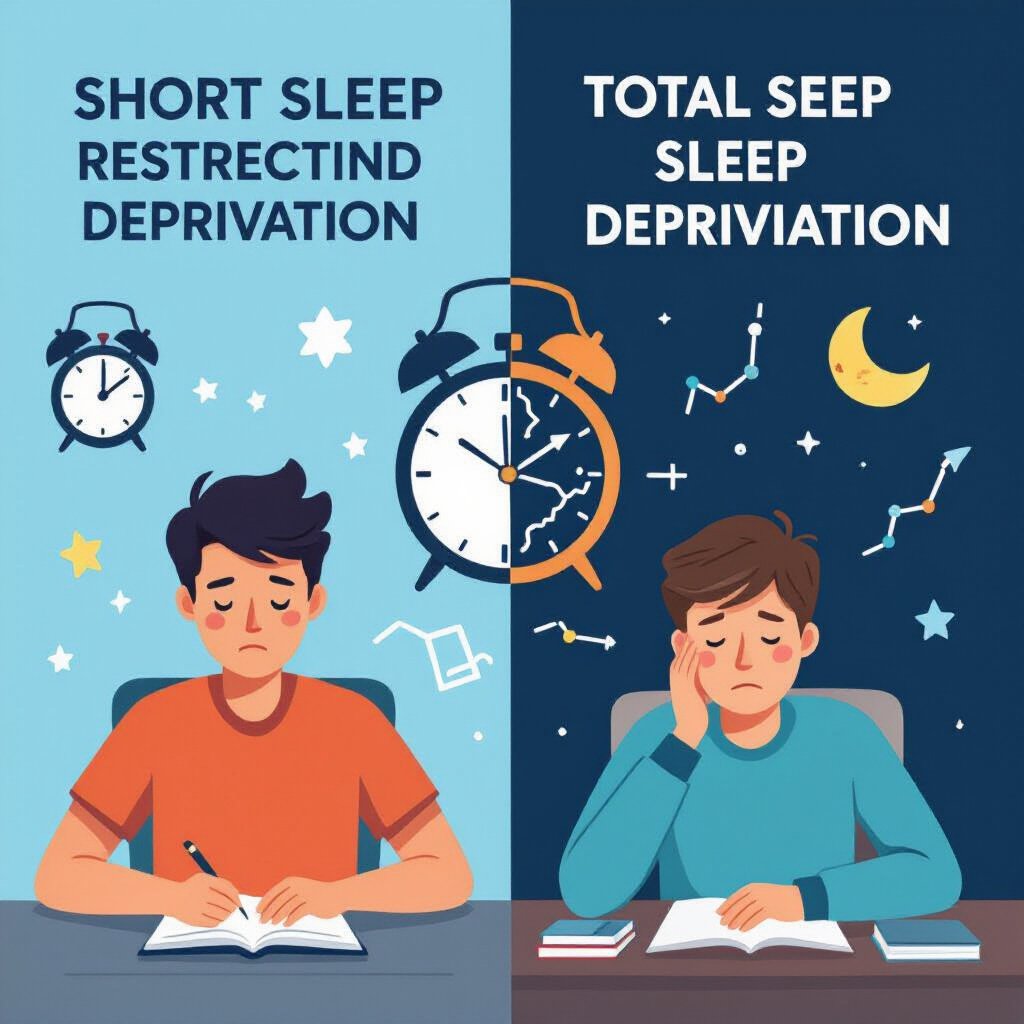
Short sleep restriction vs. total deprivation: why both can disrupt new learning
The practical difference matters. A tired person may still benefit from a shorter study session followed by sleep; an all-nighter often produces the illusion of productivity while reducing the quality of new learning. Getting enough sleep before studying helps prepare the brain to take in information, and sleep afterward helps preserve what was learned (Sleep Foundation). During sleep, the brain isn’t simply “off”; sleep supports active processing of recently learned material (News-Medical).
Also consider sleep apnea. Repeated breathing disruptions can fragment sleep without fully waking you, so ongoing problems with memory, concentration, loud snoring, gasping, or unrefreshing sleep deserve medical evaluation. Treating a suspected sleep disorder is more useful than trying to compensate with extra study time or caffeine.
Timing your learning with circadian rhythms and light for better retention
- Protect a regular sleep schedule. Going to bed and waking at roughly consistent times helps align sleep with your circadian rhythm, making it easier to stay alert during study and sleep well afterward. Sleep deprivation can impair learning, concentration, decision-making, and memory (Sleep Foundation).
- Use bright light early in the day. Outdoor daylight soon after waking helps signal that the active part of the day has begun. This can support alertness for classes, reading, or demanding work later in the morning. Light exposure is a timing cue, not a replacement for sufficient sleep.
- Schedule difficult learning when you’re naturally most alert. Some people focus best in the morning; others perform better later. Track when attention feels strongest, then place new material and problem-solving in that window. Use lower-demand tasks for periods when your energy normally dips.
- Keep bright light and stimulating screens lower before bed. A calmer, dimmer evening environment makes it easier to feel sleepy at the intended time. If late-night studying pushes sleep later, the extra review may undermine learning the next day.
- End study with a brief retrieval check, then sleep. Close your notes and recall the main ideas, explain them aloud, or answer a few practice questions. This gives the brain material to strengthen overnight; the brain can replay memories from the day during sleep as part of sleep’s contribution to memory formation.
- Don’t rely on an all-nighter before an exam or presentation. Inadequate sleep harms the ability to take in information as well as remember it later (Harvard Medical School). A shorter, focused review followed by normal sleep is usually the better trade-off.
Sleep disorders and memory: what to know about sleep apnea
Sleep apnea can affect memory by repeatedly disrupting sleep and reducing the brain’s opportunity to process newly learned information. A person may sleep for what seems like enough time yet receive fragmented, low-quality rest because breathing repeatedly narrows or stops during the night. These interruptions can also cause brief awakenings that the person may not remember, leaving daytime sleepiness, poor concentration, and mental fog.
That matters for learning before it matters for recall. If you’re struggling to stay alert during a lecture, meeting, or study session, less information is encoded in the first place. As the Harvard Division of Sleep Medicine explains, inadequate sleep affects acquisition, retention, and recall—not just the final ability to retrieve a fact. Sleep apnea may therefore make it harder to form and preserve memories, including those that depend heavily on the hippocampus.
Common clues include loud snoring, witnessed pauses in breathing, gasping during sleep, morning headaches, and persistent daytime sleepiness. Not everyone with sleep apnea snores, so unexplained memory or concentration problems deserve attention, especially when sleep feels unrefreshing. Ask a health professional whether a sleep evaluation is appropriate; diagnosis may involve an overnight study, and treatment can improve breathing during sleep. Don’t rely on extra studying to compensate for untreated disruption. Better breathing and more continuous sleep give the brain the stable conditions it needs for making the neural connections stronger and protecting what you learned.
How much sleep supports memory retention (and why quality matters)
Memory retention is best supported by enough regular, uninterrupted sleep, because both sleep quantity and quality shape how well the brain learns, stores, and later uses information. There is no single sleep duration that guarantees strong retention for everyone, but consistently cutting sleep short leaves less time for the brain to process new material. Sleeping poorly can also undermine learning before bedtime: fatigue makes it harder to focus, organize information, and use the prefrontal cortex to control attention and decision-making. As Harvard Medical School explains, inadequate sleep affects all three learning processes, including taking in information, stabilizing it, and retrieving it.
Quality matters because time in bed is not the same as restorative sleep. Repeated awakenings, irregular schedules, breathing problems, stress, alcohol, or an overly stimulating sleep environment can fragment the night. Even if the total time seems adequate, disrupted sleep may reduce the brain’s opportunity to strengthen newly learned material. Sleep deprivation is also linked with poorer memory, learning, concentration, decision-making, and emotional control, according to the Sleep Foundation.
For practical retention, protect sleep both before and after demanding learning. Sleep before studying helps the brain approach material with steadier focus; sleep afterward gives newly encoded information time to become more durable. A consistent schedule, a quiet and dark room, and attention to persistent snoring or repeated awakenings can improve the conditions memory depends on.
Evidence-aligned ways to improve sleep to boost learning
- To improve how sleep affects memory, protect sleep before learning, after learning, and throughout the night with habits you can repeat.
- Keep a regular sleep and wake schedule, including on days without classes or work. Consistency helps your body anticipate sleep and reduces the alertness swings that make studying harder.
- Plan demanding learning for a time when you’re naturally alert. Sleep before studying helps prepare the brain to take in new information, while sleep afterward helps preserve it, as the Sleep Foundation explains.
- Avoid treating an all-nighter as extra study time. Sleep deprivation can impair learning, concentration, decision-making, emotional control, and memory. It can also make it harder to focus on information in the first place, according to Harvard Medical School.
- Use a short review before bed, not a marathon session. Briefly retrieve key ideas, check errors, and stop early enough to allow a full night of sleep. This approach gives the brain useful material to process without sacrificing sleep before an exam or presentation.
- Protect sleep quality: keep the room dark, quiet, and comfortable; limit stimulating work close to bedtime; and reduce interruptions where possible. Sleep amount and sleep quality both influence learning and memory (News-Medical).
- Watch for persistent snoring, gasping, or repeated awakenings. These signs deserve medical attention because fragmented sleep can undermine learning even when time in bed seems adequate.
- Don’t expect one routine to solve every problem. Memory depends on interacting brain systems, including the parietal lobe, so combine better sleep with retrieval practice, spaced review, and realistic study schedules.
Key takeaways
- Sleep affects memory by supporting learning before sleep, strengthening newly learned information during sleep, and helping you use it later; both NREM and REM sleep contribute to this process (Sleep Foundation).
- Protect sleep before studying, not only afterward. Inadequate sleep makes it harder to concentrate on incoming information, so there may be less useful material for the brain to retain (Harvard Medical School).
- Sleep deprivation can weaken learning, memory, concentration, decision-making, and emotional control. Repeated short nights and one severely disrupted night can both interfere with effective studying (Sleep Foundation).
- Sleep supports several memory systems. Brain circuits involving the basal ganglia help with skills and habits, while other systems support facts and events; sleep loss may not affect every system in exactly the same way (Frontiers).
- The most practical plan is consistent: keep a regular sleep schedule, allow enough time for uninterrupted sleep, study with retrieval practice, and review material across multiple days rather than relying on an all-nighter.
Frequently Asked Questions
Q: How does sleep help the brain store new information?
A: Sleep supports memory consolidation, the process of stabilizing and integrating newly learned information. During sleep, the brain appears to replay patterns of neural activity associated with recent experiences, strengthening important connections and linking new material with existing knowledge. This helps memories become more durable and easier to retrieve later.
Q: Does lack of sleep affect learning, memory, or both?
A: Inadequate sleep can impair both learning and memory. Sleep loss before studying may reduce attention, information acquisition, and effective encoding. Sleep loss afterward can disrupt consolidation, while ongoing fatigue may also weaken later recall. Thus, insufficient sleep can affect multiple stages, from taking in information to retrieving it.
Q: Can sleep apnea cause memory problems?
A: Sleep apnea can contribute to memory complaints because repeated breathing interruptions fragment sleep and reduce restorative sleep quality. Episodes may also cause intermittent reductions in blood oxygen. Together, disrupted sleep and oxygen fluctuations can impair attention, learning, and memory, although the severity and persistence of problems vary among individuals.
Q: Is sleeping less before studying as harmful as sleeping less after studying?
A: Both can harm memory, but they affect different stages. Sleeping less before studying may impair attention and encoding, so information is not recorded effectively. Sleeping less after studying may interfere with consolidation, when new memories are stabilized. The relative impact depends on the amount and timing of sleep loss and the task.